|
Lincoln
university |
|
Man with
Skull |
|
An
Intellectual at Work |
|
|
|
Anthony Dickerson |
|
4/6/2010 ART 200 Spring 2010 Prof. Shahani |

|
Paul Cézanne a French painter, known for the creation of Still Life Painting, will be criticized by a Lincoln University student, from a formal, social and expressive point of view. |
Welcome…to
a doctrine of abstract proportions. A young man will take the time to analyze
three works from a renowned French painter. Born at Aix-en-Provence in the
south of France, Paul Cézanne is regarded today as one of the great ancestors
to modern painting. Many would identify him as a contemporary impressionist. He
would like to address him as one of the fathers of the post-impressionist
movement from about 1885 to 1900. Cézanne expanded on realism and is noted for
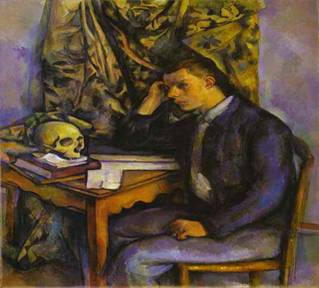
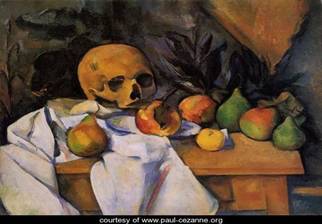
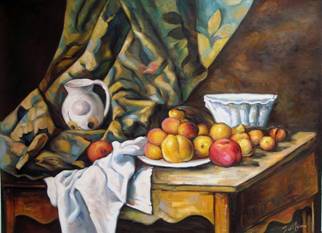
his unique treatment of space, mass, and color. Still Life with Apples and Peaches, 1905; Still Life with Skull, 1895-1900; Young Man with Skull, 1896-1898. The following painting will be
addressed in this order, and will be criticized from a formal, social, and
expressive point of view.
Still
Life with Apples and Peaches was created with oil paint on canvas. The
apples and peaches that Cézanne has captured are placed on a table. The table
is used to anchor the work of art and creates depth, by extending out from the
wall and stretching down to the ground. Cézanne uses variety and contrast to
counter the ground behind the curtain, and underneath the desk. The use of the
white vases, plate, and table cloth balances its format. The variation of hues contrast
within’ the curtain displayed on the left of the painting asymmetrically balances
the hues used to create the fruit. The vases also serve as directional forces
and draws attention to the still life in the center of the painting. The white
vase to the right counters the vase on the curtain. This is important because
it balances the various hues, and directs the eye to the center of the paper. The
white plate that the fruit is resting on creates emphasis on the fruit making
it the focal point. The pattern of the curtain creates flow and continuity,
because it shows the movement from the ceiling to the table, and the pattern
was purposely added to create continuity by it lacking in essential change. The
repetition of the fruit creates unity and emphasis. Painting was captured as
the eye sees it, and scale was ignored. However, the position of the apples,
peaches, vases, and the curtain was well place to create relation of one thing
to another. Still Life with Apples and
Peaches was a well throughout painting, and Cézanne use a great combination
of hues and brushstroke to depict his skills.
Still
life with Skull was also created with oil paint on canvas. The fruit and
skull that Cézanne has captured are placed on a desk. The desk is used to fasten
the work of art and creates depth, by pulling out from the wall and drawing
down to the ground. Cézanne uses a variation of hues to combat the darker hues
created in the ground behind the still life and skull. The use of the white table
cloth is a great representation of how Cézanne balances its format. The pattern
of the fruit creates unity. The variation of hues used to create the desk
contrast with the hues used to create the ground. This is important because it
balances the various hues, while directing the eye to the still life portrayed
on the desk. The peach rests on a white plate creating emphasis, and make it
the focal point. The white table cloth hugs the pair in the lower left corner and
serves as a directional force. This force combats the brown triangle that point
at the darker hue that appears to be leaves behind the fruit in the upper right
corner, and directs you eye to the focal point that rest in front of the skull.
The skull serves as a directional force, because it looks at the peach. The
position of each individual piece of fruit was well staged by Cézanne to
manipulate the eye to focus on the peach in the center. Sill life with Skull was another well staged painting, which
allowed Cézanne exhibit his unique use of space and color.
Young
Man with Skull as well was created with oil paint on canvas. Cézanne has
captured a man sitting at a desk staring at a skull resting on top of books lying
on the desk. Again, the desk is used to anchor the work of art and creates
depth, by stretching out from the wall and down to the ground. The curtain
behind the skull and man creates flow and continuity, because it shows the
movement from the ceiling to the table as it wraps around the skull, and the
pattern was purposely added to create continuity by its lacking in essential
change. Cézanne uses a variation of darker hues to create a sullen scene; this
conjures evil thoughts as the man stares upon the skull. He still however, uses
the hue of white to pin point the focal points within’ this particular
painting. The skull is resting on the books and on top of what it appears to be
a napkin. This directional force draws the eyes to the skull as one of its
focal points. However, the second focal point is the young man’s resting
position. The white window seal underneath the young man’s arm create a
directional force that draws the eyes to the man’s face. Oddly enough, the main
focus that Cézanne was trying to capture was the tension of the skull and the
young man staring at one another. This leaves a lot of unanswered questions,
with a lot of different interpretations. This is why Young Man with Skull is a creative and well noted work of art,
which allowed Cézanne to create expanded thought behind the brush strokes of a
unique artist.
Young
Man with Skull was created in Cézanne’s transition from what is known as
his mature period 1878-1890, to his final period 1890-1905. His mature period
was the development of his family and himself. Cézanne got married to Hortense,
and he lost his father in 1886. At the age of 47 Cézanne lost his father, and
this painting reflects his sorrow. Cézanne was also devastated when he realized
he was diagnosed with diabetes. Midway through this painting he also carried
the burden of his mother’s death in 1897. Holding on to this pain and strife,
Cézanne then reflects back upon his dark period of works. Young Man with Skull was created out of his agony reflected the
work that El Greeco influenced him to do in his dark period from 1861-1870.
Still
Life with Skull was created as Cézanne moved past the lost of his of
parents, but still was devastated by other life circumstances. Due to the
troubling events, Cézanne used painting as a vehicle of comfort. He began to
paint for long periods of time. His onset of diabetes was one of the reasons he
decided to isolate himself from others, because it changed his personality to
the point where relationships with others was a strain on his mind and body. A
person with diabetes is encouraged to eat at least five portions of fruit and
vegetables every day, and it is important to increase the amount of fruit they
eat. Therefore, the perception of death and diabetes lead to his fascination
with fruit and the creation of the Still
Life with Skull.
Still
Life with Apples and Peaches expanded upon his fascination of fruit due to
his diabetic diet. Although sill having relationship problems, Cézanne began to
move away from the darkness portrayed with the skull. He became kind of content
with his diabetes, but yet continued to paint in isolation. This isolation
continues as a direct result to his relationship problems. He longed to be by
himself so he commissioned a studio to be built along an isolated road. Here in
his studio he continued to produce paintings until his death. In this studio he
also collaborated with Emile Bernard (noted for his early works from 1886-1897,
also worked with Van Gough and Gaugiun) for a month in 1904, and this painting
shortly followed after this collaboration.
Still
Life with Apples and Peaches was chosen to exploit the connection of the
drape within Young Man with Skull.
Although, the recorded time frame is off by seven year the essence of the
curtain is still relevant. A scholar such as my-self would say that the curtain
was used to signify the place of which Cézanne painted it, and used to signify
his isolation. The curtain is a metabolic symbol for nobody can look in or out.
Thus Cézanne hid not only his-self, but his mind from individuals looking in on
his work. Cézanne’s mind was at work throughout the entire painting in various
stages; from the arrangement of objects to his very last brush stroke. The
hidden meaning within this painting is everything in life is not pure, but the
good stands out. This meaning is conveyed by the white table cloth (pure) being
covered by the curtain (evil) and the vase resting on the curtain (pure out
shine/ or over comes evil). Still Life
with Apples and Peaches is both pretty and beautiful in the eyes of
scholars.
Still
Life with Skull was chosen to exploit the connection of the skull within Young Man with Skull. The time period
for these two work of arts actually over lap. The skull is significant within
each painting because it signifies his mental state at the time. Cézanne
endured a lot of hardships and losses prior to creating these paintings, and
may have even entertained the thought of suicide. Not only did the skull
signify suicide but displayed his perception of death, and leads to the hidden
meaning of the painting. Death is inevitable. All human life must come to an
end at some point and time. Even fruit cannot maintain the same form forever.
This is represented by the skulls constant stare at the piece of fruit on the
plate. Cézanne not only captured an overarching theme, but went against all in
one work of art. By painting the true forms of each fruit allowed the fruit to
receive everlasting form as he transformed them onto the canvas. Still Life with Skull is a combination
of despair and hope that allows hope to have an everlasting form and/or
existence.
Young Man with Skull was chosen in
the likeness of my-self. When a scholar first lays eyes on this work of art, he
can in vision himself sitting at that very same desk with the same deep look on
his face. Although, Cézanne painted this work over a hundred years ago, it is
still relevant in today’s society. The painting depicts a young man (obviously
a scholar with reference to the books) in deep thought. This painting can be
interpreted in many different ways. However, due to Cézanne’s life circumstance
one can narrow it down to one obvious interpretation. The intellectual young
man is seating there pondering on death. The painting’s hidden meaning can best
be defined by a known quote used in many literary text, “Is life worth living?”
or “I do not know if I can continue further.” Cézanne artistically expanded on
the symbolism of the skull to create a pictorial concept to death and despair.
This is why Young Man with Skull is
relevant today and will continue to be for years to come.
Young
Man with Skull,
1896-1898
Still
Life with Skull,
1895-1900
Still
Life with Apples and Peaches,
1905
Bibliography
Paul Cezanne
Wikipedia, the Online Encyclopedia
March, 30 2010.
March, 22 2010.
http://en.wikipedia.org/wiki/Paul_C%C3%A9zanne
Paul Cezanne
Young Man with Skull
1886-1889
Olga’s Gallery
http://www.abcgallery.com/C/cezanne/cezanne33.html
March, 22 2010.
Paul Cezanne
Still Life with Skull
1895-1990
The Archive
http://artchive.com/artchive/C/cezanne/skull.jpg.html

March, 22 2010.
Paul Cezanne
Still Life with Apples and Peaches
1905
The Collection
http://www.nga.gov/collection/gallery/gg80/gg80-45986.html
March, 22 2010